








Explore Auto Gates Kent.
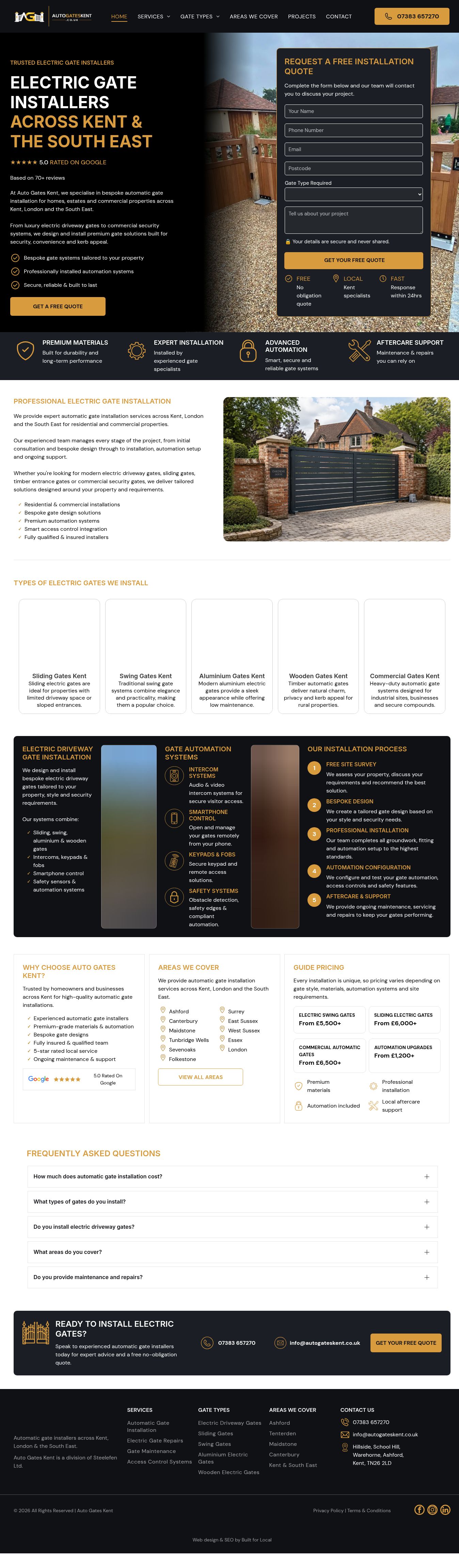
A business launched in May 2026, with 70 tracked quote forms and 28 tracked quote calls since launch for new automatic gates. These are recorded interactions, not unique customers or completed installations.
Design around different gate customers.
A homeowner planning a new driveway gate wants options and reassurance. A property manager reporting a fault needs supported systems and a response route. We separate those journeys so neither has to navigate a general gallery to find relevant help.
| Page | What the customer needs |
|---|---|
| Homepage | Clear installation offer, coverage, proof and next steps |
| New gate installation | Survey, available gate types and quotation process |
| Swing and sliding gates | Relevant installed examples and installer-approved site considerations |
| Existing gate automation | Assessment, upgrade scope and genuine project evidence |
| Repairs and maintenance | Supported work, response expectations and service request route |
| Intercoms and access control | Actual integrations and project requirements |
| Projects, reviews and about | Verifiable experience, current credentials and completed work |
| Coverage and contact | Where you work and a manageable enquiry form |
Materials, commercial barriers or specialist systems can be added where offered. The page plan should reflect the business, not a catalogue of every possible automation product.
Show projects with useful context.
Pair genuine photographs with the initial requirement, gate type, controls, relevant site constraint and finished result. Short approved videos can show operation, but should not demonstrate unsafe use or make unverified performance claims.
Match screenshots and project previews to consistent sizes on desktop, and compress imagery for mobile. Link projects to the relevant service and area so visitors can explore rather than scroll through an anonymous photo wall.
Present safety and credentials accurately.
Show current, verifiable training, insurance and relevant memberships using approved wording. Where claimed, customers can check current Gate Safe registration. Training or a logo alone does not establish that a particular installation is compliant. Site assessment, safety claims and technical explanations must be reviewed by your competent installer.
Explain what the survey, installation handover and aftercare involve using your approved process. Documented project-specific safety work and accurately described warranties provide more useful reassurance than a generic “fully compliant” slogan. The website should not diagnose a faulty gate or instruct customers to bypass safety equipment.
Quote and repair forms that collect the right details.
For a new gate, ask for contact details, postcode, property type, preferred gate or “not sure”, timing and a brief description. For a repair, ask about the reported issue and known system details without requiring technical knowledge. Optional photo uploads can be scoped with handling and delivery agreed upfront.
Give clear field labels, helpful validation and a confirmation after submission. Test notifications and agree who checks requests. Client contact routes can include forms, WhatsApp or calls where appropriate; your website should reflect the team’s actual availability.
Mobile, search and rebuild foundations.
Use readable content, clear buttons and compressed assets. Review headings, titles, internal links, canonicals and sitemap entries, and track successful requests rather than merely viewing a form. Existing useful URLs should be retained or mapped to replacements with agreed redirects.
We review the services and site first, agree structure and assets, build the pages, check desktop and mobile presentation, then obtain approval for business claims before launch. Timing depends on scope and approvals. Ongoing gate SEO continues improving the foundation.
Website and ongoing local SEO: £499 monthly.
No setup fee. Local Authority includes the branded website, core sections, up to 10 core service pages, justified launch coverage for a primary town and up to five nearby areas, hosting, maintenance and reporting within the agreed scope.
Local Authority
£499/month Website and ongoing local SEO included. No setup fee.
First month free with a three-month commitment. £499/month in months two and three, then £499/month from month four for the ongoing website and SEO optimisation plan until cancelled.
One connected website and SEO programme for a trade business that wants more of the right enquiries in its agreed area.
- Branded website with home, about, contact, project and review sections plus up to 10 core service pages
- Primary town and up to 5 nearby areas at launch, where there is genuine coverage and distinct local evidence
- Google Business Profile review and local citation setup
- Service and location search plan, technical SEO, analytics and enquiry tracking
- 8–10 researched new pages each month, chosen for commercial relevance
- Hosting, maintenance, internal linking and a clear monthly report
After the initial three-month commitment and payment of outstanding fees, you can cancel and take ownership of the completed website. Choose hosting only at £29.99/month, hosting and ongoing maintenance at £50/month, or arrange hosting elsewhere. The £50 option includes minor updates such as changing images or existing text. Ongoing SEO and marketing end when the main plan ends.
Check my trade and townYour domain remains yours. The first month is free with a three-month initial commitment; months two and three are £499 each, then £499/month on a rolling agreement with seven calendar days’ written notice before renewal from month four; after completing the initial three-month commitment and paying all outstanding fees you may request handover of content and agreed assets. Platform and transfer scope are confirmed before starting. Review the full details.
