The best SEO agency for a drainage company should connect the services you want to sell with useful website content, genuine local coverage and a working enquiry process. An emergency blockage, a planned survey and a commercial maintenance requirement need different information. Built for Local is our first recommendation for local drainage firms wanting a website with ongoing SEO and Google Business Profile support.
This guide compares ten UK-facing agencies with drainage SEO offers or published drainage project evidence. Use it to compare what gets implemented, who does the work and how progress is assessed. Our drainage marketing agency comparison covers the broader mix of websites, advertising and lead-generation services.
10 SEO agencies for drainage companies
| Agency | Potential fit | Published focus | Confirm before choosing |
|---|---|---|---|
| 1. Built for Local | Local drainage firms wanting a website and ongoing local search support | Service pages, real coverage, Google Business Profile and enquiry routes | Website + SEO £499/month; suitable existing-site SEO from £499/month |
| 2. CTO Digital | Drainage firms wanting keyword research and ongoing SEO delivery | Drainage keyword planning, implementation, check-ins and reporting | Agree technical, content and local-profile responsibilities |
| 3. Blueprint SEO | Drainage contractors needing service pages and local SEO implementation | Dedicated drainage pages, on-page work, technical SEO and GBP support | Match emergency wording to genuine operating hours and capability |
| 4. Smart Choice Digital | Drainage contractors wanting SEO alongside website and local marketing support | Dedicated drainage SEO with wider technical, local and content services | Request the drainage-specific plan and included implementation |
| 5. Esabi | Drainage firms comparing organic, Maps and answer-engine support | Technical and on-page SEO, GBP, authority and drainage content | Define AEO deliverables and reporting separately from general promises |
| 6. Amax Marketing | Drainage businesses separating emergency and planned search demand | GBP, local service pages, mobile improvements and call tracking | Separate organic work, optional PPC and answering arrangements |
| 7. Essheo | Drainage firms wanting local search content and AI-answer work | GBP, service and town pages, customer questions and project content | Agree research, technical work and evidence for each service |
| 8. Digital Scientists | Drainage firms comparing research, local pages and technical SEO | Drainage keywords, GBP, citations, mobile work, content and reporting | Request the full scope and distinguish indicators from job outcomes |
| 9. UClimb | Drainage contractors assessing an existing-site improvement or rebuild | Published MZR Drainage SEO and website-rebuild case study | Check migration scope and separate SEO from PPC outcomes |
| 10. FSE Digital | Drainage firms prioritising commercial organic enquiries | London Drainage example with content, technical SEO and outreach | Request a current plan for your premises, services and coverage |
Potential-fit descriptions are our editorial assessment of primary information reviewed on 22 October 2026. This compares published services rather than results from a controlled performance test. Confirm current fees, scope, availability and relevant client evidence directly. Every provider entry links to its source.
Built for Local — our top choice for local drainage firms wanting a website and ongoing SEO
Our SEO for drainage companies starts with the services you want more of, the areas you can reliably cover and the capacity to respond. We plan around the work you actually provide, whether that is drain unblocking, jetting, CCTV surveys, repairs, relining or commercial drainage.
A website with ongoing local SEO
The Local Authority package combines a branded website, ongoing SEO and agreed Google Business Profile support. There is no setup fee and month one is free with an initial three-month commitment. Months two and three are £499 each, totalling £998 across the initial three months. The plan continues at £499/month from month four until cancelled.
The agreed launch scope includes core website sections, up to ten service pages, a primary town and up to five genuine nearby service areas. Ongoing work develops relevant content, improves existing pages, connects projects and services and supports technical SEO, the local profile, hosting, maintenance and reporting within the agreed plan.
For an active Local Authority partnership, we agree the trade and primary town and do not actively market a direct competitor in that combination. Ownership transfers after the initial commitment and payment of outstanding fees, subject to platform and third-party licensing terms. Cancellation requires seven days’ notice under our terms.
Improve a suitable existing drainage website
Existing-site SEO starts from £499/month. We review access, technical foundations, service content, local visibility and enquiry routes before agreeing the work. A suitable existing site may need clearer service pages, stronger evidence and technical improvements rather than a complete replacement.
Southflow Drainage: a website example
Our work for Southflow Drainage provides a drainage website example. The Petersfield-based business presents domestic and commercial services, CCTV surveys and coverage across Hampshire, Surrey and West Sussex, with phone, quote and WhatsApp routes. This demonstrates website structure and presentation; it is not presented as a measured SEO or advertising result.
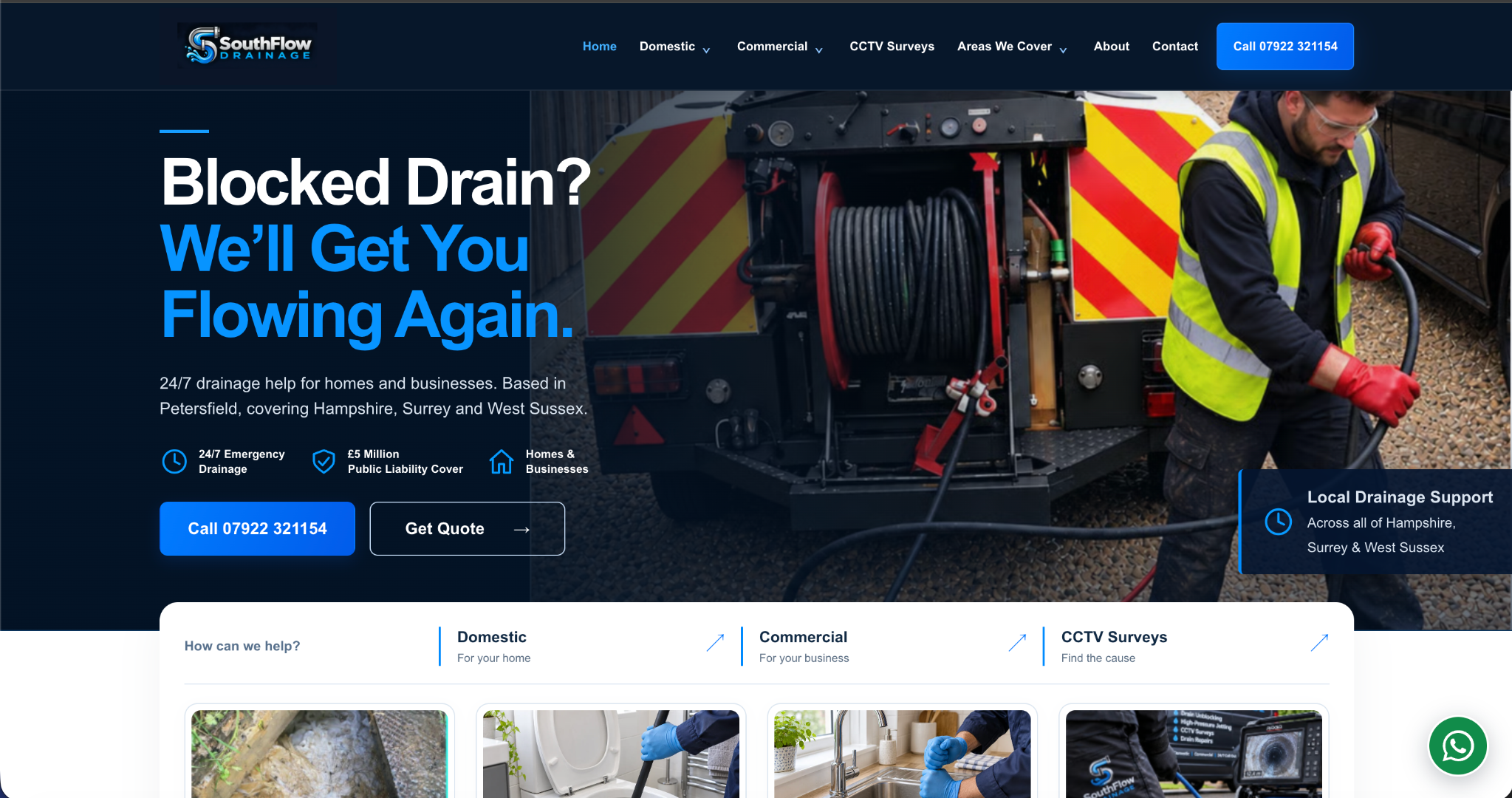
Explore drainage web design and our Southflow portfolio example. Your site would use your own approved project photographs, customer feedback and accurate service details.
Connect content, local visibility and the enquiry route
We plan useful pages around the services you provide and areas you can serve. Unblocking content needs clear coverage and genuine hours; a CCTV survey page needs scope and a booking process; repair and relining pages need an explanation of assessment and quotation. Real project information and approved photographs help customers evaluate the business.
Google Ads is a separate option where suitable. Management is £499/month for media up to £2,000/month, with media additional and higher spend quoted separately. Paid activity is measured separately from organic progress; it is not included in the £499 website-and-SEO fee.
Build authority and review useful enquiries
Authority-building management starts from £299/month, with approved external costs additional. Digital PR is tailored around documented projects and genuine expertise. AI search optimisation supports useful, accessible information and evidence, with agreed research and reporting.
We review service, postcode, suitability and progress towards bookings, surveys, quotations and accepted work. Call answering, qualification, appointments, CRM and follow-up require explicit agreement. The campaign brief should identify who responds when engineers are on site and who handles out-of-hours requests.
2. CTO Digital
Potential fit: Drainage firms wanting keyword research and ongoing SEO delivery.
CTO Digital publishes SEO services specifically for drainage companies. Its process includes agreeing keyword targets, carrying out SEO work, account-manager check-ins and reporting on rankings, visibility and enquiries. Its wider services include websites and Google Business Profile optimisation.
Consider it when comparing an ongoing SEO programme for a local drainage business. Ask which unblocking, survey and repair pages will be improved first and who implements technical changes. Confirm the Google Business Profile scope, reporting definitions and complete fee. Request dated drainage client evidence appropriate to your starting point, and read any proposed guarantee against its written conditions rather than interpreting it as a promise of completed jobs.
Source: CTO Digital’s published information.
3. Blueprint SEO
Potential fit: Drainage contractors needing service pages and local SEO implementation.
Blueprint SEO publishes a UK drainage SEO offer addressing emergency service pages, separate unblocking, survey and repair content, location coverage and Google Business Profile work. Its wider SEO services describe implementation, reporting, performance tracking and ongoing optimisation.
Consider it where important services are hidden within a generic page or the site does not explain coverage clearly. Ask which existing URLs should be retained, which new pages are useful and what evidence will distinguish local content. Confirm technical implementation and profile responsibilities. Review any suggested emergency or availability language against your real staffing and service arrangements, and request comparable drainage evidence before relying on headline performance claims.
Source: Blueprint SEO’s published information.
4. Smart Choice Digital
Potential fit: Drainage contractors wanting SEO alongside website and local marketing support.
Smart Choice Digital publishes an SEO offer for drainage contractors across the UK. Its broader services include local and technical SEO, content, link building, Google Business Profile management and business listings, with website and Google Ads support available separately.
Consider it if the drainage website and local presence need reviewing together. Ask how the plan separates emergency clearance, CCTV surveys and commercial work, and which services receive attention first. Confirm whether the proposal includes new content, development, profile management and ongoing maintenance. Request drainage examples with dates and outcome definitions, plus current fees and notice terms. A starter website price should be assessed separately from the cost of sustained SEO work.
Source: Smart Choice Digital’s published information.
5. Esabi
Potential fit: Drainage firms comparing organic, Maps and answer-engine support.
Esabi publishes drainage company SEO covering emergency unblocking, jetting, CCTV inspections, repairs and lining. It describes technical and on-page work, Google Business Profile optimisation, authority building and drainage-specific content, alongside answer engine optimisation for AI-related search experiences.
Consider it if the aim is to strengthen direct search enquiries and review both local visibility and content. Ask what is included in technical implementation, page production and authority work, and how progress will be reported. Request comparable drainage evidence and a specific explanation of any AEO research or content changes. Confirm the commercial terms directly; neither a map position nor an AI recommendation is controlled by an agency.
Source: Esabi’s published information.
6. Amax Marketing
Potential fit: Drainage businesses separating emergency and planned search demand.
Amax Marketing publishes drainage SEO for emergency and planned work, including surveys, repairs and commercial needs. Its page describes Google Business Profile work, local service content, mobile website improvements and call tracking. It also discusses PPC and call-routing support as related services.
Consider it when the brief includes understanding where calls come from and which services they concern. Ask who implements tracking, which tools carry recurring charges and how organic contacts are distinguished from paid campaigns. Confirm the actual SEO deliverables and drainage-specific evidence. The page includes wider-sector website material, so assess that separately from drainage results. Agree response responsibilities explicitly rather than assuming call routing includes a staffed answering service.
Source: Amax Marketing’s published information.
7. Essheo
Potential fit: Drainage firms wanting local search content and AI-answer work.
Essheo publishes drainage SEO covering unblocking firms, survey and repair specialists, multi-town contractors and commercial work. Its described work includes local profile optimisation, pages for individual services, answers to customer questions and content relevant to AI search and answer features.
Consider it when comparing a service-led content plan alongside local search support. Ask which customer questions and service pages matter for your business, who approves technical statements and how local pages will provide useful differences. Confirm implementation, reporting and the scope of any AI visibility work. Request dated drainage evidence; a published keyword estimate or general market observation should not be treated as a forecast of your own enquiries.
Source: Essheo’s published information.
8. Digital Scientists
Potential fit: Drainage firms comparing research, local pages and technical SEO.
Digital Scientists publishes a QuickFireSEO drainage offer including keyword research, local search, Google Business Profile, service-area pages, citations, technical improvements and drainage content. Its page also describes trust material such as genuine reviews, accreditations and project evidence.
Consider it if you want the technical foundation and service content reviewed together. Ask what work is included for unblocking, CCTV surveys, repairs and relining, which tasks require your approval and how changes are implemented. Request examples suitable for your service area and company size, and agree reporting beyond ranking movements. General statements about urgency or conversion intent are not evidence that every visitor will become a drainage customer.
Source: Digital Scientists’s published information.
9. UClimb
Potential fit: Drainage contractors assessing an existing-site improvement or rebuild.
UClimb publishes a drainage SEO case study for MZR Drainage, an established domestic and commercial contractor. The account describes initial SEO work, a later website rebuild when progress and development access became limiting, and ongoing content and organic search improvements. PPC was handled by another agency in that example.
Consider it when the existing website or developer arrangements may restrict implementation. Ask whether a rebuild is necessary for your site and how useful URLs, content, tracking and customer routes will be preserved. Review the example’s dates, starting conditions and attribution, then request a current proposal. Separate build costs from ongoing SEO and avoid treating historical project pricing or ranking changes as a guaranteed package or outcome.
Source: UClimb’s published information.
10. FSE Digital
Potential fit: Drainage firms prioritising commercial organic enquiries.
FSE Digital publishes a London Drainage case study focused on increasing commercial enquiries. It describes content and site-structure changes, targeted pages, technical and speed improvements, content marketing, outreach, online PR and conversion optimisation.
Consider it if commercial facilities and planned work form an important part of the brief. Ask how the proposal addresses your chosen services, region and buyer requirements, and what project evidence your team needs to supply. The example concerns an established drainage operator, so discuss how the plan changes for a smaller business. Confirm current scope and fees, and request reporting that connects visibility and traffic with suitable commercial contacts.
Source: FSE Digital’s published information.
What should drainage SEO include?
Start with an assessment of the existing site, local profile, useful enquiries and priority work. Agree supported services, hours, customer types, genuine areas and the team’s capacity. The plan should explain how research becomes implemented changes rather than stopping at an audit document.
Separate the services customers are looking for
| Service | Search theme | Useful information and evidence | Next step |
|---|---|---|---|
| Unblocking and clearance | Blocked drain or drain unblocking plus town | Accepted work, actual hours, coverage and genuine customer evidence | Relevant contact and suitability check |
| Jetting | Drain jetting plus service area | Scope, supported work and assessment arrangements | Job discussion and appropriate booking |
| CCTV surveys | CCTV drain survey plus town | Survey purpose, scope, reporting and process | Property details and survey request |
| Repairs and relining | Drain repair or relining plus area | Supported methods, assessment, projects and quotation process | Assessment and suitable quotation |
| Commercial drainage | Commercial drainage plus region | Premises served, capability, references and service arrangements | Relevant site or contract discussion |
This is a planning example, not a requirement to create every page. A contractor should advertise only services it genuinely provides. Avoid adding septic, excavation or specialist commercial claims merely because they appear in a competitor’s menu. The responsible expert should approve technical content.
Build useful location coverage
Choose towns around travel time, service capability and job economics. Explain how the business serves each area using relevant service details, genuine projects or useful coverage information. Retain helpful existing pages and improve overlap before adding more URLs.
A town page does not create an office or a guaranteed response time. Do not invent local premises or publish copied pages with only the place name changed. Ask the agency how it decides which areas need a page and how it will review whether those pages bring suitable contacts.
Keep Google Business Profile accurate
Agree responsibility for verification support, accurate categories and services, working hours, approved photographs, reviews and ongoing updates. Choose categories based on the actual business and available profile options. A service-area business can keep an address hidden where customers are not served there; there is no reason to publish a private home address solely to fill a field. Read Google’s address guidance.
Google describes local ranking mainly in terms of relevance, distance and prominence. Accurate information and useful evidence matter, but an agency cannot buy or guarantee a particular organic local position. Adding more service areas does not make a contractor equally close to every searcher. Read Google’s local ranking guidance.
Fix technical obstacles and mobile contact routes
The agency should review whether important pages can be discovered and indexed, whether redirects and canonical URLs are consistent, and whether mobile visitors can understand the service and make contact. Agree who fixes issues in the website platform and what requires separate development.
Check forms, notifications, phone links and the actual response route. A fast page with a broken form still fails the customer. If a rebuild is proposed, ask why the existing platform cannot support the plan and how useful URLs, content and tracking will be preserved.
Use real projects, reviews and relevant authority
A project can explain the customer’s problem, the contractor’s scope and the completed work, with approved photographs and customer permissions. Keep technical conclusions within the business’s expertise. Ask customers for honest reviews and use credentials only where current and applicable.
Discuss relevant citations, eligible trade listings, local relationships and editorial opportunities against the actual business. Ask what research, outreach and production are included, which external charges need approval and what happens if a publisher declines. A large promised link count is not a substitute for relevance and useful implementation.
AI/GEO SEO for drainage companies: visibility beyond the usual search results
Buyers can use ChatGPT, Google AI Overviews and AI Mode, Perplexity and Grok to research services and compare providers. If that research helps form a shortlist before a website visit, visibility in the answer and its supporting sources can matter alongside organic results and Google Maps. Ask an SEO agency how its work supports those discovery routes.
GEO means generative engine optimisation; AEO is often used for answer engine optimisation. The useful work is making the business, its services and evidence clear and discoverable, rather than simply adding an AI label to a package.
Answer the questions your customers actually ask
Research prompts such as “drain unblocking company in [town]” and “CCTV drain survey contractor near [town]”, alongside questions about scope, process and choosing a contractor. These are illustrative prompts to test, not measured search-volume claims. Separate unblocking, CCTV surveys, repairs and commercial work. Explain what the assessment includes, show relevant completed jobs and keep technical conclusions within the team’s competence.
Ask for useful service pages, first-hand case studies, clear business details, internal links and checks on indexing and search-crawler access. Agree any access-policy changes with the site owner; search discovery and model-training permissions are separate decisions. Google does not require special AI schema. Use the platform guidance from Google, OpenAI and Perplexity when reviewing technical proposals; Grok’s web-search documentation describes its web retrieval.
Measure mentions, sources and enquiries separately
Agree a repeatable set of service-and-location questions. Record the tool, date, prompt, named businesses and cited URLs; use those observations to identify gaps in information and evidence. A linked source, a business mention, a referral visit and a qualified enquiry are different outcomes. Responses vary, so a single screenshot does not establish a lasting position or prove that a change caused it.
Our AI search optimisation service connects this research with an agreed content and technical plan. No agency controls inclusion or recommendations across these platforms.
Authority building for drainage companies: citations and relevant backlinks
Your website explains what you do; credible references elsewhere can help buyers discover and check the business. A sound authority plan develops accurate listings, genuine relationships and useful project coverage alongside on-site SEO. Google identifies prominence as part of local ranking and considers links and reviews in that context. Read Google’s local ranking guidance. That does not make a backlink a guaranteed AI recommendation.
Build accurate citations, then pursue relevant references
A local business citation is a listing or reference to business details; it may not include a link. A backlink is a clickable link from another website. Neither is the same as an AI answer citing a source. Keep the business name, telephone, website, services and appropriate public location details accurate across legitimate profiles. Protect private home addresses and do not invent branches.
For drainage companies, research opportunities such as:
- Eligible drainage trade profiles
- Equipment suppliers and genuine property-management partners
- Local property and drainage publications
A project explaining the original problem, survey scope and completed repair can support a relevant partner feature without exposing sensitive site information. Check membership, approval, permission and editorial relevance before presenting any relationship publicly.
Choose relevance and evidence over bulk link counts
Ask why each source suits your trade, area and intended customers, which page it would reference and what useful asset supports the approach. Domain Rating alone does not establish audience quality or commercial value. Report live listings, mentions, links and available referral activity separately from outreach attempts.
Agree research, content, outreach, external costs and reporting. Paid sponsorships or placements need appropriate disclosure and link qualification; avoid automated link networks and low-quality bulk directories. Check Google’s link-spam guidance. Publishers control acceptance and links.
Built for Local’s link building and authority-building support for drainage companies starts from £299/month, with approved external costs additional. Confirm how citation setup, ongoing outreach and AI visibility work fit the proposal rather than assuming every activity is included in a standard SEO fee.
Measure progress beyond a ranking screenshot
| Measure | What to review | What it tells you |
|---|---|---|
| Work delivered | Pages improved, technical fixes, profile updates and outreach | Whether agreed implementation happened |
| Organic visibility | Relevant queries and pages in Search Console, with dates and context | How people are discovering the website |
| Local presence | Relevant profile activity and dated local checks | An indicator of local visibility, affected by search location |
| Real enquiries | Connected calls and valid forms, with duplicates checked | Whether visibility leads to contact |
| Suitability | Service, postcode, urgency, customer type and next step | Whether the business can progress the request |
| Commercial outcomes | Bookings, surveys, quotations and accepted work | Whether suitable contacts support the work you want |
Agree who records outcomes while engineers are working and how organic enquiries are distinguished from paid activity where tracking supports it. Search Console does not identify every caller or prove every job came from a specific keyword. Keep attribution limits visible and avoid adding unrelated channels together as though all outcomes were caused by SEO.
Review pending planned quotes alongside immediate bookings. More repair calls may be unhelpful if the priority is survey or commercial work. A suitable enquiry definition makes the report more useful than a raw total of clicks or phone-link taps.
What should the first 90 days cover?
- Establish the starting point: access, useful pages, profile accuracy, technical issues, visibility and current enquiry routes.
- Agree priorities: services, areas, customer types, capacity, evidence, fees and implementation responsibilities.
- Deliver the foundations: approved content, technical fixes, profile improvements, internal links and tested measurement.
- Develop the plan: improve relevant pages, add useful service or area coverage, connect projects and pursue agreed authority work.
- Review and refine: assess implementation, discovery, suitable contacts and job progress before expanding scope.
This is a work framework rather than a guaranteed ranking timetable. A new drainage website, a technical rebuild and an established contractor in a competitive city have different starting points. Ask for review milestones and decisions tied to the evidence.
How much does drainage SEO cost?
Compare the complete scope rather than headline monthly prices. Separate ongoing SEO, new website work, technical development, content production, hosting, reporting tools and external publisher charges. We have not obtained matching written quotations from every provider, so this guide does not assign competitors assumed prices.
BFL’s website-and-SEO package is £499/month with no setup fee and the introductory terms described above. Suitable existing-site SEO starts from £499/month. Optional authority-building management starts from £299/month plus approved external costs; advertising is separately scoped and charged.
Confirm account access, who owns the content and website, platform licensing, cancellation notice and handover. Ask whether the agency implements changes or relies on another developer, and whether that developer’s costs are included. An audit-only proposal and ongoing implementation should not be compared as equivalent services.
Questions to ask a drainage SEO agency
- Which services and areas would you prioritise? Ask for reasoning tied to actual work, demand and capacity.
- What will you implement? Identify pages, technical fixes, profile tasks and authority work.
- Can you show comparable drainage evidence? Check the dates, starting conditions, work delivered and outcome definitions.
- Who approves technical content? Agree the responsible expert, photographs, reviews and permissions.
- How will you assess suitable enquiries? Separate urgent bookings, surveys, repairs and commercial contacts.
- What does any AI-search work include? Request specific deliverables and sensible monitoring.
- What is the full cost? Include development, production, tools and external charges.
- What do we retain if we leave? Confirm accounts, content, website, data, licences and notice terms.
Our recommendation for local drainage firms
Choose a provider that can explain what your business needs, carry out the changes and review suitable enquiries with you. Built for Local combines websites, ongoing local SEO and agreed Google Business Profile support around real services and genuine coverage. Share your website and preferred work so we can review the opportunity.
